

Every security vendor now promises smarter, faster protection driven by artificial intelligence. For a business owner or IT lead, the pitch is compelling, but the real question is not whether the technology works. It is whether it fits your situation, budget, and risk. Adoption is already widespread: a recent survey found that 25% of small and mid-sized businesses now use AI specifically to strengthen cybersecurity, and nearly half upgraded their defenses in the past year. Before you join them, it helps to weigh the benefits against the trade-offs honestly. This guide walks through what the technology does, who gains the most, and how to decide whether it belongs in your stack. There is no universal yes or no here, only a fit that depends on what you protect and who protects it.
Key Takeaways
- AI-driven security applies machine learning to detect and respond to threats faster than manual methods.
- The biggest gains go to businesses lacking a 24/7 team, handling sensitive data, or growing quickly.
- Real trade-offs exist: upfront cost, false positives, data quality needs, and a reliance on human oversight.
- It is not a silver bullet; it works best layered on strong basics and guided by people.
- For most businesses facing AI-scaled attacks, AI-assisted defense now warrants serious consideration.
What This Technology Actually Does
At its core, this technology uses machine learning to learn what normal activity looks like across your systems, then flags anything that deviates. Instead of matching known threats against a fixed list, it reads behavior, which helps it catch new and disguised attacks. It is worth understanding what AI powered cyber security offers before weighing whether your business needs it.
In practice, that means quicker threat detection, automated responses to routine incidents, and the ability to sift through far more data than a human team could. The promise is real, but so are the conditions under which it pays off. Think of it less as a single product and more as a capability that can live inside your existing tools or arrive as a managed service. Either way, the engine is the same: patterns, not fixed rules.
The Benefits: Why Businesses Adopt It
The appeal comes down to speed, scale, and coverage. AI does not tire, so it can watch your systems around the clock and flag anomalies in seconds. It scales as your business grows without a matching rise in headcount, and it can surface threats that have never been seen before. For smaller teams, this opens up protection once reserved for large enterprises. It also cuts down on the routine work that wears staff out, freeing people to focus on the incidents that genuinely need a human eye. That shift alone changes how a lean team spends its day.
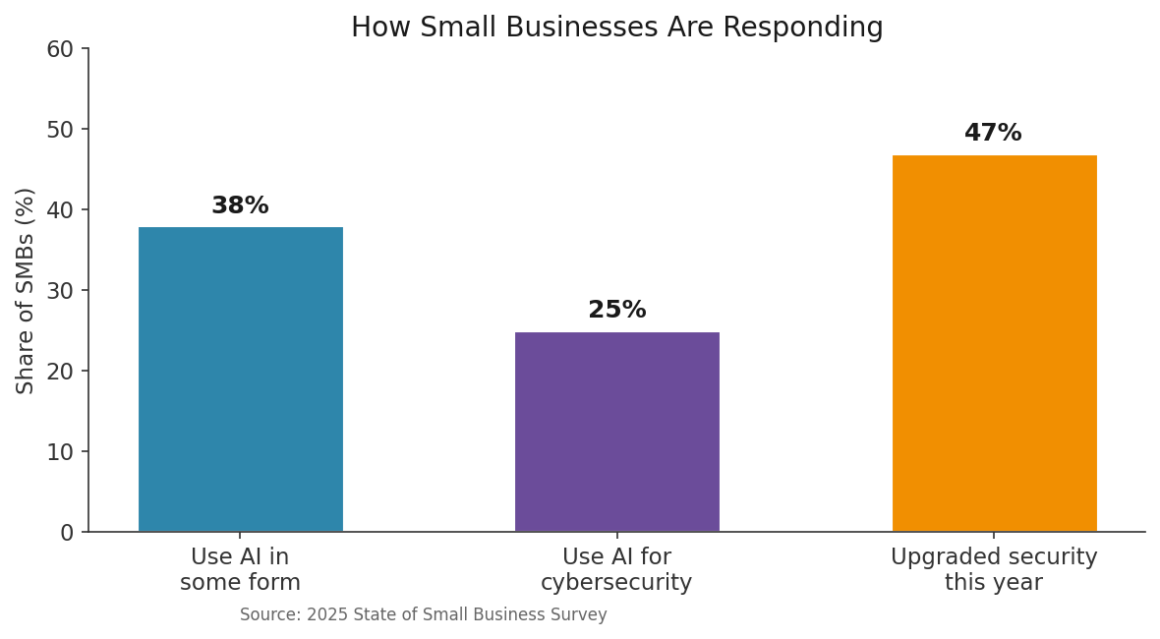
Adoption is climbing, though cybersecurity use still trails general AI use.
The financial case is concrete too. This kind of real-time, AI-driven monitoring shortens the gap between a breach starting and being contained, which is where most of the cost lands.
|
Key stat: organizations that use AI extensively in their defenses save close to 1.9 million dollars per breach and contain incidents about 80 days faster, according to IBM. |
The Trade-offs to Weigh
No technology is free of downsides. AI-powered tools carry an upfront cost, both for the software and the skills to run them well. They can generate false positives that bury real threats in noise, and they depend heavily on clean, representative data to make good calls. There is also the risk of over-reliance: a system that acts on a wrong conclusion can cause harm quickly.
|
Upside |
What to watch |
|
Detects threats in real time, day and night |
Carries upfront cost and setup effort |
|
Scales without adding headcount |
Depends on clean, quality data |
|
Spots novel, previously unseen attacks |
Can produce false positives |
|
Cuts through alert overload |
Still needs human oversight |
|
Opens enterprise-grade defense to small teams |
Cannot stand on its own |
That is why human oversight stays essential. The strongest results come from pairing automation with AI that supports rather than replaces people, where analysts validate the system’s calls and handle the decisions that carry real weight.
“The window for reactive security approaches is closing.” Deloitte Insights
|
Warning: watch for compliance too. If you handle regulated data, feeding it into an AI tool without the right controls can create privacy violations. Map where AI can and cannot operate before you deploy. |
None of these drawbacks is a reason to avoid AI outright. There are reasons to adopt it with eyes open: budgeting for setup, tuning it to your environment, and keeping a person accountable for what the system does.
Who Is It Right For?
AI-powered defense is not equally valuable to every business. It shines brightest for organizations that handle sensitive or regulated data, lack the staff for round-the-clock monitoring, or are growing fast enough that their attack surface keeps expanding. Attackers now use AI to target even small firms, so being small is no longer a reason to assume you are safe.
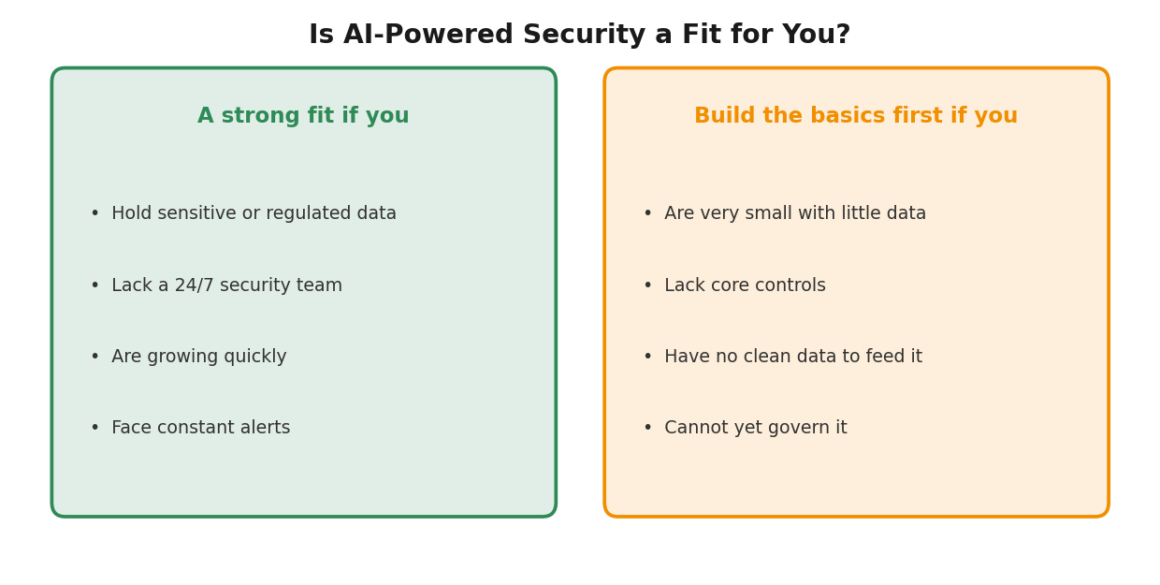
A quick gut check on whether the timing is right for your business.
For a very small business with little data and few systems, the smarter first move is often to get the basics right before layering AI on top. To see how peers are approaching it, a recent small business survey offers a useful benchmark. The pattern in that data is clear: adoption climbs fastest among businesses that have already felt the cost of a close call.
[Video: “AI in Cybersecurity: How Artificial Intelligence Protects Your Business”: https://www.youtube.com/watch?v=WL395R95450]
This short explainer shows how AI-driven protection works for a business in practice.
How to Decide
Start with an honest look at your gaps. What data do you hold, what would a breach cost, and who is watching your systems at 2 a.m.? Then match the answer to your resources. Many businesses begin with a pilot on their highest-risk systems, or choose a managed service so they gain AI-driven protection without building a team from scratch.
|
Ask yourself |
Why it matters |
|
What sensitive data do we hold? |
Higher stakes strengthen the case for AI defense |
|
Who watches our systems overnight? |
Coverage gaps are where AI helps most |
|
Is our attack surface growing? |
Faster growth means more to monitor |
|
Do we have clean data and core controls? |
AI performs only as well as its foundations |
Whatever you choose, keep the foundations solid. AI works best on top of fundamentals like strong two-factor authentication and clear governance, not as a replacement for them. Treating cybersecurity as a core business priority rather than an afterthought is what turns a tool into real protection. Revisit the decision periodically, too. Your data, your team, and the threats all change, so a tool that looks like overkill today may be essential a year from now.
|
Pro tip: run a short pilot before committing. Measure how quickly the tool detects and contains a test threat, and how many false alarms it raises. Real outcomes beat vendor promises every time. |
Frequently Asked Questions
What does AI-powered security actually mean?
It is the use of machine learning and behavioral analysis to detect, analyze, and respond to cyber threats faster than traditional, rule-based tools. It learns normal patterns and flags anomalies.
Is it worth it for a small business?
Often yes. Smaller firms gain around-the-clock, enterprise-grade protection without hiring a full team, which matters as attackers increasingly target them. Cloud-based and managed options keep it affordable. The key is to match the tool to your actual risk rather than buying the biggest option available.
What are the main downsides?
Upfront cost, potential false positives, dependence on quality data, and the danger of leaning on it too heavily. It also needs human oversight and careful handling of regulated data.
Does AI replace my IT or security staff?
No. It automates detection and speeds response, but people still validate findings, investigate complex cases, and make high-stakes decisions. It supports your team rather than replacing it.
How do I get started?
Assess your gaps and data sensitivity, keep core controls in place, and run a small pilot or use a managed service. Judge tools on how fast they detect and contain real threats, and let that result, not the sales pitch, drive the final call.
The Verdict
So, should your business adopt AI-driven defense? For most organizations facing today’s fast, AI-driven attacks, some form of it is worth serious consideration, especially if you handle sensitive data or lack round-the-clock coverage. But it is a tool, not a magic fix. The businesses that benefit most are the ones that adopt it deliberately: on top of strong basics, guided by human judgment, and matched to their real risks and resources. Weigh the trade-offs, start where the risk is highest, and let the value prove itself before you scale. Done well, that measured approach is how a security upgrade becomes a genuine advantage rather than just another line item.
References
Verizon, 2025 State of Small Business Survey. https://www.verizon.com/about/news/2025-state-small-business-survey
IBM, Cost of a Data Breach Report 2025. https://www.ibm.com/reports/data-breach
World Economic Forum, Global Cybersecurity Outlook 2026. https://www.weforum.org/publications/global-cybersecurity-outlook-2026/
NIST, Artificial Intelligence Risk Management Framework (AI RMF 1.0), 2023. https://www.nist.gov/itl/ai-risk-management-framework
Deloitte Insights, Using AI in Cybersecurity, 2025. https://www.deloitte.com/us/en/insights/topics/technology-management/tech-trends/2026/using-ai-in-cybersecurity.html
Fact Check: All statistics and data points in this article were verified against original sources as of July 6, 2026. Sources are listed in the References section.