
Key Takeaways
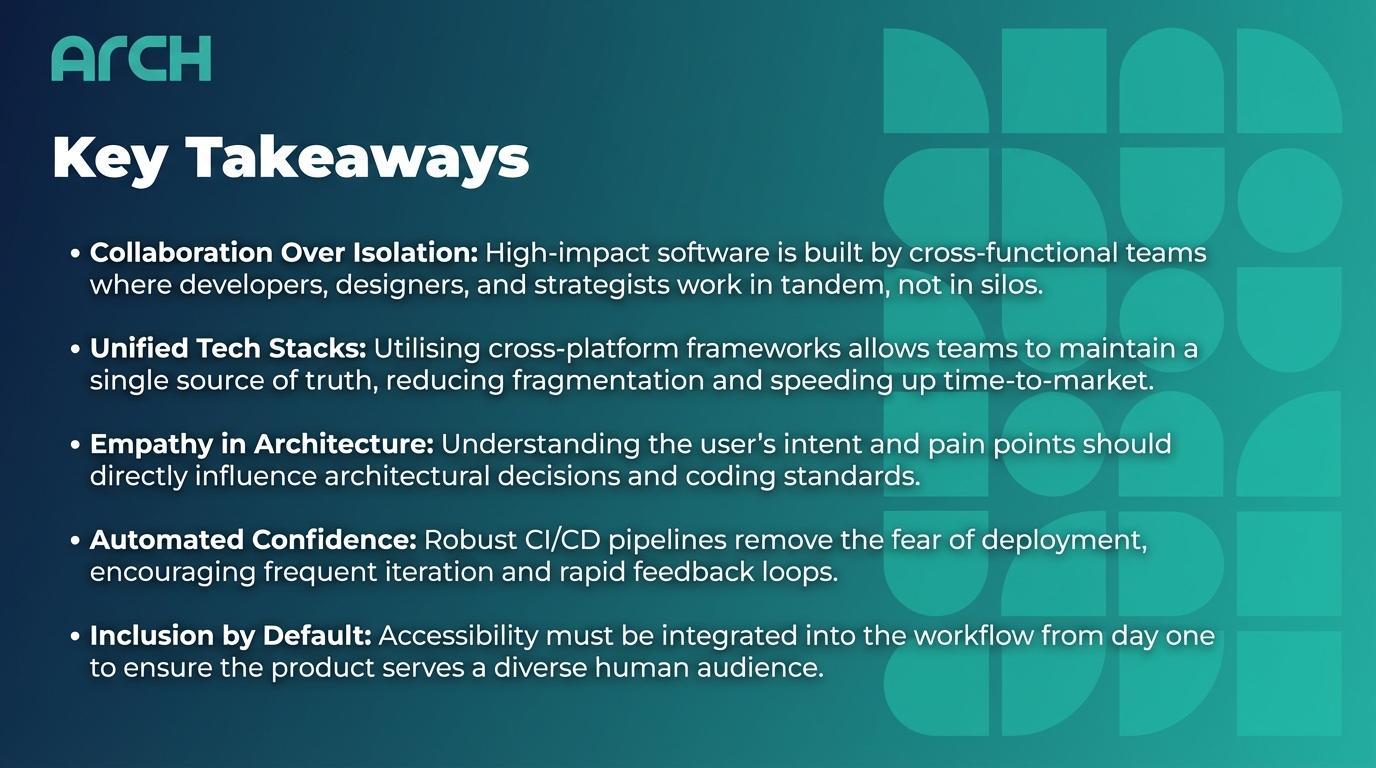
Collaboration Over Isolation: High-impact software is built by cross-functional teams where developers, designers, and strategists work in tandem, not in silos.
Unified Tech Stacks: Utilising cross-platform frameworks allows teams to maintain a single source of truth, reducing fragmentation and speeding up time-to-market.
Empathy in Architecture: Understanding the user’s intent and pain points should directly influence architectural decisions and coding standards.
Automated Confidence: robust CI/CD pipelines remove the fear of deployment, encouraging frequent iteration and rapid feedback loops.
Inclusion by Default: Accessibility must be integrated into the workflow from day one to ensure the product serves a diverse human audience.
The myth of the solitary genius coder, typing away in a dark room to change the world, is rapidly fading. In today’s high-stakes technology landscape, the most impactful digital products are born from collective intelligence. They are the result of collaborative codebases where design, development, and strategy converge.
For organisations aiming to deliver genuine value, the focus must shift from mere code generation to optimising the entire development workflow. This ensures that every line of code serves a human need. It transforms the codebase from a static repository into a dynamic engine for innovation.
When we prioritise human-centred workflows, we do more than just ship software faster. We create digital ecosystems that are accessible, resilient, and deeply aligned with the end-user’s reality.
The Shift Towards Empathy-Driven Engineering
Historically, software development workflows were linear and often siloed. Requirements were tossed over a wall to developers, who then passed a finished product to QA. This assembly-line approach often resulted in technically functional products that failed to resonate with users.
To counter this, modern workflows must integrate empathy at the architectural level. This means developers are not just receiving tickets; they are understanding the ‘why’ behind the feature. When engineering teams understand user pain points, the codebase reflects a solution-oriented mindset rather than a feature-driven one.
Integrating Design and Development
The friction between design and engineering is a well-documented bottleneck. However, shared workflows and design systems act as the bridge. By utilising component-driven development, teams can ensure that the visual language and the code logic speak the same dialect.
This alignment reduces technical debt and ensures that the user interface remains consistent. It empowers teams to iterate based on user feedback without unravelling the underlying architecture.
Strategies for Optimising Collaborative Workflows
Optimisation is not about squeezing more hours out of the day; it is about removing friction. A high-impact workflow is transparent, automated where possible, and rigorously communicative.
Leveraging Cross-Platform Efficiency
One of the most effective ways to foster collaboration is by unifying the development environment. Fragmented teams working on separate codebases for iOS and Android can often lead to feature parity issues and disjointed user experiences.
Technologies that allow for a single codebase to serve multiple platforms streamline this significantly.
For example, experienced flutter app developers Arch can build high-performance applications for both operating systems simultaneously.
This approach allows the entire team to focus on refining one robust codebase, ensuring faster iteration cycles and a unified product vision.
Continuous Integration as a Culture
Continuous Integration (CI) and Continuous Deployment (CD) are often viewed as purely technical practices. However, they are fundamentally cultural tools. By automating testing and deployment, teams create a safety net that encourages experimentation.
When a developer knows that their code will be automatically tested against the broader system, they are more confident in making necessary changes. This reduces the ‘fear of breaking things’ that often stifles innovation in legacy codebases.
Accessibility as a Core Metric
Human-centred innovation is impossible if large segments of the population are excluded. Accessibility cannot be an afterthought applied at the end of the development cycle. It must be woven into the fabric of the workflow.
Optimised workflows include accessibility checks within the code review process. This ensures that semantic HTML, proper contrast ratios, and screen reader compatibility are treated with the same importance as security or performance.
By embedding these standards early, we avoid costly retrofits. More importantly, we ensure the final product is truly inclusive, reflecting a commitment to serving all users regardless of ability.
Conclusion
The future of software development lies not in the complexity of the code, but in the clarity of the collaboration. By optimising our workflows to prioritise human connection—both within the team and with the end-user—we unlock a higher tier of innovation.
A collaborative codebase is a living document of an organisation’s problem-solving capability. When managed with empathy and precision, it becomes a powerful asset for driving meaningful change. As expert partners in this journey, our goal is to ensure that technology remains a bridge to human potential, not a barrier.
About the Author
Hamish Kerry is the Marketing Manager at Arch, where he’s spent the past six years shaping how digital products are positioned, launched, and understood. With over eight years in the tech industry, Hamish brings a deep understanding of accessible design and user-centred development.
Frequently Asked Questions
1. What is the biggest barrier to a collaborative codebase? The biggest barrier is often communication silos. When design, development, and business teams use different terminologies and tools without a shared system, friction occurs, leading to slower delivery and disjointed products.
2. How does cross-platform development improve workflows? It reduces duplication of effort. Instead of maintaining two distinct codebases (and two distinct teams) for iOS and Android, a unified framework allows the team to focus their collective energy on refining a single, high-quality product.
3. Why is accessibility considered part of workflow optimisation? Fixing accessibility issues after launch is significantly more expensive and time-consuming than building them in from the start. Integrating accessibility checks into the daily workflow streamlines the process and ensures a higher-quality output.
Sources
Google Cloud: State of DevOps Report
W3C: Web Content Accessibility Guidelines (WCAG) Overview