
Are you looking for a reliable supply-side platform? Many of them take too much time to master due to their overly complicated design. Plus, you risk losing value if the inventory is affected by fake bids or bots.
In the listing, you’ll find the 5 best programmatic advertising platforms that:
- Have operated for at least five years
- Enable global ad placement
- Ensure data transparency
- Work with all popular ad formats and channels
Scroll down to find the most helpful AdTech partner.
- Smarty Ads
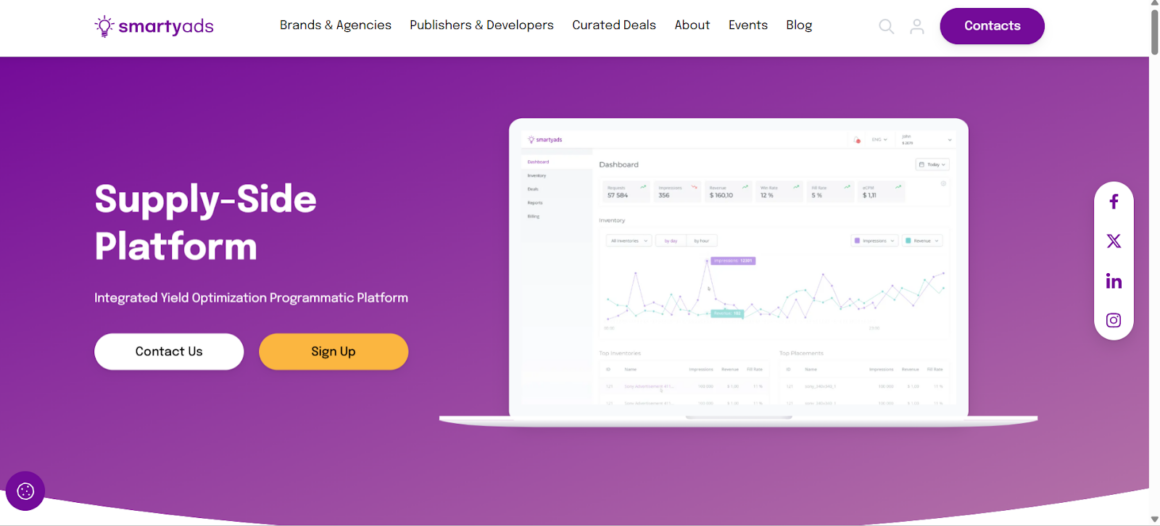
Smarty Ads is a leading international company that has been operating for 14 years. They provide a supply-side platform and a DSP for sellers and buyers. The company had partnerships with Google, Reface, Opera, and many other big businesses.
The company has one of the top SSP platforms for monetizing ad space. It provides publishers with access to hundreds of demand sources, including big DSPs, ad networks, and agencies, to optimize competition and earning potential. The product supports header bidding, so that publishers can get the highest possible price for each ad impression.
The dashboard shows live statistics, detailed reports, and blocks unwanted ads. It’s user-friendly and allows the management of large volumes of inventory with heavy traffic.
Smarty Ads offers one of the best demand-side platforms to set up multichannel campaigns. Its users can target by location or device, retarget past visitors, and optimize budgets to ensure their ads engage the most relevant audiences.
Both platforms work smoothly and support all formats and devices. The company was ranked by G2 as a high performer in 2023 and has a 4.5-star rating on the website. It has also been honored with several awards, including the Stevie Awards, DADI Awards, SIA Awards, and MarTech Breakthrough Awards.
- Adform

Adform is another global company headquartered in Denmark. It has developed tools for monetizing and buying ad space. They position themselves as an “all-in-one” system, meaning their DSP and the supply side platform work together.
The team has developed one of the best supply-side platforms that gives more control over selling ad space. Publishers can choose which advertisers can use specific ad spaces, set pricing floors, and complete private transactions thanks to the SSP. They can also use header bidding to boost competition for each ad impression. For handling massive inventory volumes, the SSP provides configurable APIs, real-time data, and comprehensive reporting.
Adform has created one of the top DSP platforms that enables agencies and businesses to buy digital advertisements on multiple types of platforms, including connected TV, display, and video. It also enables Digital Out-of-Home advertising, which means that it makes the brand’s ads visible on digital screens at shopping malls, bus stops, and other public places. The DSP’s strong connection with the SSP and data platform provides users with a better understanding of campaign results and reduces data loss between systems.
The company has strong feedback from customers on SoftwareReviews. People like the platform’s ease of use and its value for money. It has also received multiple awards from Adweek and Red Dot Awards and has worked with such big clients as Lenovo, Tchibo, and Vodafone.
- OpenX
OpenX is an independent ad-tech company based in California. It offers a top programmatic ad platform and has worked with more than 200,000 global businesses for 18 years.
Their supply-side platform facilitates connections between publishers and a vast network of advertisers and demand partners. Publishers can specify pricing restrictions, make their items available for real-time bidding, determine which buyers can access certain placements, and access detailed performance reports. Additionally, OpenX provides curated inventory packs to let publishers sell premium impressions and assist advertisers in reaching highly relevant audiences.
- Magnite

Magnite entered the market in 2020, after the merger of Rubicon Project and Telaria. Since then, it has become one of the biggest independent companies, providing one of the best ad networks for publishers. Their client portfolio includes major brands such as Netflix, Samsung, Spotify, Disney, and Warner Bros. Also, they’ve recently signed a partnership with the X platform.
Magnite’s supply-side platform is primarily built for CTV and premium video, instead of focusing on display ads, but it does support them. Other ad formats include audio, DOOH, mobile in-app, and native ads. The company actively invests in long-form video technologies, TV-style ad delivery systems, pod management tools, audience analytics, and direct integrations with major streaming platforms.
The platform has a unique feature, ClearLine, which gives advertisers a direct channel to premium video inventory, avoiding the need for a traditional DSP. ClearLine allows agencies and brands to access inventory through a streamlined buying channel within Magnite’s system, rather than entirely depending on outside buying platforms. This lowers costs, bridges the gap between publishers and buyers, and enhances transparency.
- Index Exchange
Index Exchange is among the top 5 ad exchange companies on the market, based in New York. Their SSP enables selling ad space across all popular formats through a unified system.
The company strongly focuses on quality and transparency, following GDPR, using fraud-prevention tools, and blocking low-quality sites from showing ads. Their platform helps publishers boost the value of their inventory before reaching the buying side by supporting complex deal structures, in-depth analytics, and integrations with audience or contextual data.
The platform stands out with its supply-side audience activation feature, which allows publishers to use data and audience segments directly inside the SSP instead of extra tools. This makes it easier for media owners to compete fairly with big, closed digital platforms that typically dominate both sides of the market.
Conclusion
When searching for a supply-side platform, consider more than just the features. Look at the partner networks, transparency standards, support quality, and real case studies. Publishers should pay attention to fraud protection capacities and yield tools. Advertisers should evaluate targeting opportunities and how detailed the reporting is. All top programmatic AdTech companies described above have been on the market for a long time, earning the trust of well-known clients and maximizing their earning potential.